
The Role of ICT Test Probes in Manufacturing
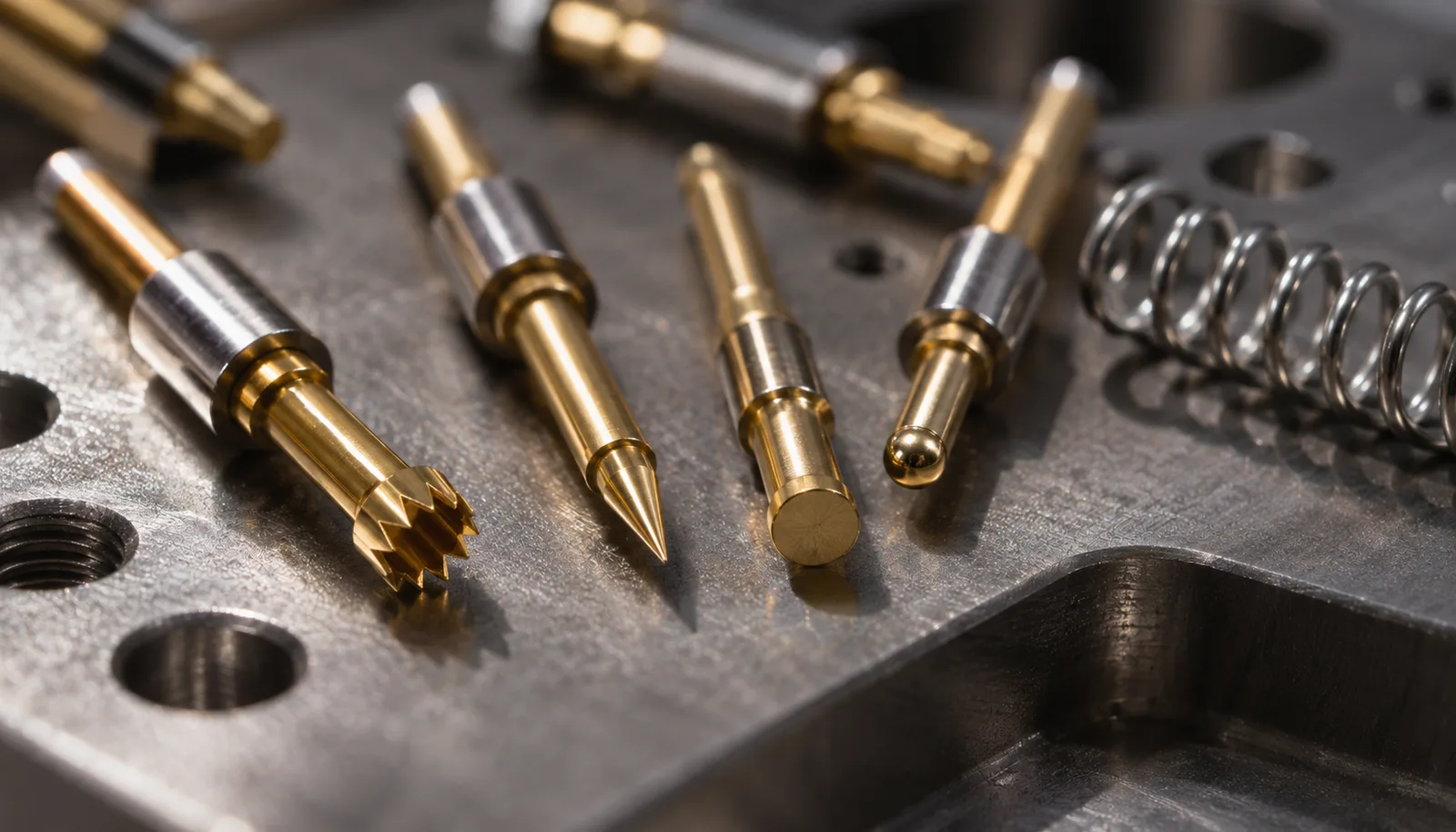
In-circuit testing (ICT) is a critical step in printed circuit board assembly, ensuring every node on a board functions correctly before it leaves the factory. The heart of any reliable ICT fixture is its set of ict test probes. These spring-loaded connectors must make consistent, low-resistance contact with thousands of test points across a PCB. Manufacturers like Promax Pogo Pin, a high-tech enterprise founded in 2014, specialize in the precision pogo pins and spring-loaded connectors that form the basis of these probes. In 2026, the diversity of PCB designs demands a wide variety of probe tip styles. Here are the top 10 tip styles and their specific applications.
- 📞 Phone
- (765) 705-7361
General Purpose and Sharp Probe Styles
1. Crown Tip
The crown tip is one of the most common styles used in ICT fixtures. Its concave, multi-pointed contact surface provides excellent grip on flat PCB pads and traces. The multiple points ensure redundant contact, which helps break through light surface oxidation. This style is ideal for general-purpose testing of standard PCB nodes.
2. Spear Tip
Also known as a chisel tip, the spear probe is designed to pierce through heavier oxidation or contamination on a test pad. Its sharp, pointed edge concentrates force onto a very small area, making it highly effective for testing solder joints or pads that are not perfectly clean. It is a staple in high-reliability ICT setups where contact resistance must be minimized.
3. Convex Tip
For applications where surface marking is a concern, the convex tip offers a smooth, rounded contact surface. It is often used on gold-plated or delicate test points where a sharp probe could cause damage. The convex shape provides a consistent contact patch without digging into the material.
Specialized Probe Styles for Complex Geometries
4. Concave / Serrated Tip
When testing spherical contacts or ball connectors, a concave or serrated tip provides a secure mechanical grip. The serrated edges increase the friction between the probe and the target, preventing slippage during the test cycle. This style is common in automotive and aerospace PCB testing.
5. Bifurcated (Twin) Tip
A bifurcated probe splits into two separate contact points. This is specifically used for testing components that have two closely spaced contact pads. It allows a single probe to verify a differential signal or a pair of connections simultaneously, simplifying the fixture design.
6. Tri-Furcated (Tripod) Tip
Similar to the bifurcated tip but with three points, the tripod style offers exceptional stability on uneven or contoured surfaces. It is frequently used for testing IC packages or modules where the contact plane is not perfectly flat. The three points ensure at least two are always making solid contact.
Advanced and Application-Specific Tip Styles
7. Stepped Tip
Stepped probes feature a recessed tip that is narrower than the probe body. This design allows the probe to reach deep into a socket or a recessed test pad without the barrel contacting the surrounding board. It is essential for testing connectors and sockets on densely populated PCBs.
8. 4-Point / 5-Point / 6-Point Tips
For ultra-high-reliability testing, multi-point probes provide multiple redundant contact paths. These are used in mission-critical applications where a single point of failure is unacceptable, such as in medical devices or avionics. The multiple points also help distribute the spring force, reducing wear on the test pad.
9. Flat Tip
The flat tip provides the largest surface area for contact. It is used for testing large bus bars, battery contacts, or high-current nodes. The broad contact area minimizes resistance and heat generation during high-current testing.
10. Custom Ground Tips
When standard geometries cannot match the unique shape of a device under test (DUT), custom ground tips are the solution. Manufacturers like Promax Pogo Pin offer custom machining to create tips that perfectly match a specific pad geometry, ensuring optimal signal integrity and mechanical stability.
Material Selection and Probe Performance
The tip style is only half the equation. The material and plating of the probe are equally critical. Beryllium copper (BeCu) is the industry standard for its excellent spring properties and conductivity. Steel offers higher durability for high-wear applications, while tungsten is used for extreme hardness. Platings such as gold, nickel, and rhodium are applied to reduce contact resistance and prevent corrosion. When selecting a probe, it is important to consider the mating cycle life, the required contact force, and the environmental conditions of the test floor. Matching the right tip style with the correct material ensures long fixture life and accurate test results.
Conclusion
The landscape of PCB manufacturing in 2026 demands precision and adaptability. From the classic crown tip to highly specialized custom ground probes, the variety of ICT test probe tip styles allows engineers to design fixtures that handle any challenge. Understanding the specific geometry of your test pads and the electrical requirements of your test is the first step. Partnering with an experienced manufacturer ensures you get probes that perform reliably over millions of cycles. Whether you need standard off-the-shelf probes or a fully custom solution, the right tip style is the foundation of a successful in-circuit test strategy.